So here’s the headliner: the recession contributed to an increase in overall homelessness from 2008 to 2009, and family households experienced the largest percentage increase. The increases, coupled with worsening economic and demographic indicators of homelessness, paint an austere picture of The State of Homelessness in America (National Alliance to End Homelessness, 2011).
Other Major Findings:
The nation’s homeless population increased by approximately 3 percent from 2008 to 2009. The largest percentage increase among subpopulations was in the number of family households experiencing homelessness, which increased by over 4 percent. In Mississippi, the number of people in homeless families increased by 260 percent.
The doubled up population increased by 12 percent to more than 6 million people from 2008 to 2009. In Rhode Island the number increased by 90 percent; in South Dakota the number more than doubled.
Nearly three-quarters of all U.S. households with incomes below the federal poverty line spent over 50 percent of monthly household income on rent. Forty states saw an increase in the number of poor households experiencing severe housing cost burden from 2008 to 2009.
California, Florida, and Nevada – states known to have been disproportionately impacted by the recent housing crisis – have high rates of homelessness and high rates of unemployment, foreclosure, housing cost burden, lack of insurance, and doubling up.
People in doubled up living situations, released from incarceration, and aged out of foster care are twice as likely to experience homelessness than the average poor person; these populations are twenty times as likely to experience homelessness as the average American.
So the verdict is: the state of homelessness isn’t great.
In fact, Nan Roman (President, NAEH) points out, “These findings project what depressed wages, stagnant unemployment, unrelenting housing cost burden, and the lagging pace of economic recovery really means: increases in homelessness and heightened risk of homelessness for more and more Americans.”
Which is why it’s time for us to renew our commitment to ending homelessness.
As the new Congress and the Administration work to revitalize the American economy, it’s our job to make it clear that must include homelessness interventions in the recovery strategy – clearly, as these data show, curbing and ending homelessness is a critical part of economic recovery.
Want more? Check out the report online.
Catherine An is the Media Relations and Communications Specialist at the Alliance. This blog first appeared on the National Alliance to End Homelessness Blog, About Homelessness.
Tuesday, January 25, 2011
Tuesday, December 28, 2010
The Gift (Part 2) by Madelaine Sayko
Continued from previous blog...
I wonder too what will happen in January and February, in March or May or July - when the impetus of good cheer fades and the need does not. Homelessness is not seasonal; and in fact the summer months often see a rise in the number of families with no place to live. The reality is that we cannot gather enough clothes and food and toys and household items to really turn the tide; those things may sustain for a bit, but lives cannot really improve if there are no jobs, no health care and no places to live.
But even beyond that there is one aspect of homelessness and poverty that is usually overlooked, one aspect that may in many ways inform these other vital needs. What others often don’t realize is the simple fact of just how lonely a place poverty is.
Studies have shown that familiarity with others – be they of a different ethnicity, religious belief, race or economic status – is a key factor in reducing prejudice and improving collaboration and understanding. So long as the poor are ‘out there,’ so long as the giving is not face to face, it is hard to understand, support and enact the kind of underlying changes that are needed to make a lasting difference because one can remain apart, one can see this as an act of charity and not humanity.
Human interaction is an essential part of any life; it is precious, it is empowering, it gives us a sense of meaning, of worth. To be ignored, to be invisible is to be meaningless; yet this is what poverty does for it is brutally lonely.
The homeless cannot have you over to their house – they have no house. The poor cannot go out to dinner they do not have the money, they cannot meet their friends for coffee and chat about the struggles and joys of raising children for there is no place to meet, they cannot hang out to watch the game on TV with their pals for they have no TV and they have no pals. They do not go to museums or book clubs or the movies. They do not have a community for even when they try to form one it will change; these are the vicissitudes of their circumstance.
The poor lack the entryway to one of life’s most basic pleasures; that of camaraderie, of companionship. When you have no income and no place to live your life gets small and direct; every day is about surviving that day, about managing the crisis you are facing now, about shelter and food and holding on Not having an income doesn’t mean more leisure time; it means no leisure time.
To be poor means that your dreams are reduced to the smallest possible existence, that you learn to keep your own company, head low, barely noticed; its better that way. You keep your feelings to yourself even as you hunger not only for a meal but equally for something that you cannot find in the food pantry; a voice to answer yours, a conversation, a human touch. Relationships, time with others, the art of sharing, a hug to ease ones fears; these moments buoy the spirit and give hope, they heal and nurture but the truth is that they are absent for the poor. For them poverty is only heartbreakingly lonely.
So this is what I hope – I hope that after this holiday season passes by we do not give up, we do not think we are done, that the gap has been filled. I hope that we will keep our awareness alive, that we will keep making our material contributions, even if they don’t seem to fill the vast space of need.
But beyond that I also hope that we see people who are homeless, who are poor, who are in need as people, that we learn to cross our paths with them, to talk with them, to employ them, to break bread with them, to even make them our friends. I hope that we find a way to give of ourselves, to embrace those who are without so that we can truly recognize these folks as people and perhaps change the course of their lives and the course of our own.
Ms. Sayko is a senior manager in health care who also works to improve conditions for those who struggle with illness, injury, poverty and homelessness.
The photo, "Hope for the Holidays," by ewitsoe is used with permission.
I wonder too what will happen in January and February, in March or May or July - when the impetus of good cheer fades and the need does not. Homelessness is not seasonal; and in fact the summer months often see a rise in the number of families with no place to live. The reality is that we cannot gather enough clothes and food and toys and household items to really turn the tide; those things may sustain for a bit, but lives cannot really improve if there are no jobs, no health care and no places to live.
But even beyond that there is one aspect of homelessness and poverty that is usually overlooked, one aspect that may in many ways inform these other vital needs. What others often don’t realize is the simple fact of just how lonely a place poverty is.
Studies have shown that familiarity with others – be they of a different ethnicity, religious belief, race or economic status – is a key factor in reducing prejudice and improving collaboration and understanding. So long as the poor are ‘out there,’ so long as the giving is not face to face, it is hard to understand, support and enact the kind of underlying changes that are needed to make a lasting difference because one can remain apart, one can see this as an act of charity and not humanity.
Human interaction is an essential part of any life; it is precious, it is empowering, it gives us a sense of meaning, of worth. To be ignored, to be invisible is to be meaningless; yet this is what poverty does for it is brutally lonely.
The homeless cannot have you over to their house – they have no house. The poor cannot go out to dinner they do not have the money, they cannot meet their friends for coffee and chat about the struggles and joys of raising children for there is no place to meet, they cannot hang out to watch the game on TV with their pals for they have no TV and they have no pals. They do not go to museums or book clubs or the movies. They do not have a community for even when they try to form one it will change; these are the vicissitudes of their circumstance.
The poor lack the entryway to one of life’s most basic pleasures; that of camaraderie, of companionship. When you have no income and no place to live your life gets small and direct; every day is about surviving that day, about managing the crisis you are facing now, about shelter and food and holding on Not having an income doesn’t mean more leisure time; it means no leisure time.
To be poor means that your dreams are reduced to the smallest possible existence, that you learn to keep your own company, head low, barely noticed; its better that way. You keep your feelings to yourself even as you hunger not only for a meal but equally for something that you cannot find in the food pantry; a voice to answer yours, a conversation, a human touch. Relationships, time with others, the art of sharing, a hug to ease ones fears; these moments buoy the spirit and give hope, they heal and nurture but the truth is that they are absent for the poor. For them poverty is only heartbreakingly lonely.
So this is what I hope – I hope that after this holiday season passes by we do not give up, we do not think we are done, that the gap has been filled. I hope that we will keep our awareness alive, that we will keep making our material contributions, even if they don’t seem to fill the vast space of need.
But beyond that I also hope that we see people who are homeless, who are poor, who are in need as people, that we learn to cross our paths with them, to talk with them, to employ them, to break bread with them, to even make them our friends. I hope that we find a way to give of ourselves, to embrace those who are without so that we can truly recognize these folks as people and perhaps change the course of their lives and the course of our own.
Ms. Sayko is a senior manager in health care who also works to improve conditions for those who struggle with illness, injury, poverty and homelessness.
The photo, "Hope for the Holidays," by ewitsoe is used with permission.
Labels:
Charity,
Economic Crisis,
Giving,
homeless,
homelessness,
Madelaine Sayko,
New York,
Sustainability
Sunday, December 26, 2010
The Gift (Part 1) by Madelaine Sayko
The other day I was in my beloved NYC, walking down 5th Avenue. It was an intoxicating moment; NYC at Christmas time – the cacophony of visitors, fur-trimmed, leather adorned, polar fleeced and down puffy, the slightly frenzied madness of families with wandering glassy-eyed children, ingĂ©nues who insist no matter the weather on wearing spike heels, the ubiquitous hot dog vendors (with everything of course), the smoky scented chestnut roasters, carols swirling past in the air punctuated by ringing bells and voices laughing and talking in a zillion different tongues. The gleaming star up by 57th street…and then there is the tree, oh the tree with its glorious blanket of lights, surrounded by wooden soldiers and angels and ice-skaters, bursting with a sense of festivity. And the stores, recession? What recession, the stores glitter and gleam with bounty, silk and elegance, their windows filled with fantasy worlds.
Then I stopped in front of Harry Winston. In the window was a necklace of breathtaking beauty, the facets of diamonds literally danced with fire and light. But even as I admired the magnificence of its beauty a thought came to me: how many people could live in safe homes and have food to eat for the whole of next year for the price of that single object?
Now, I understand that there is not a scale here – a necklace or the lives of 50 people, and I don’t expect folks to deny themselves beauty or pleasure or even very expensive things. But I think its important to pay attention. In that same bit of holiday madness were a few folks on the street corners, dressed more soberly than the rest. They were selling a magazine written by the homeless, it was a struggle for them to make their voices heard. And on the home front I noticed that our local paper had a small announcement: 43 people died from homelessness this past year. Interestingly this was placed under a much larger article that spoke about a crime problem in another community. Three individuals had been attacked and the police commissioner was quoted as saying, “Three is a big number.” Well, 43 is a big number too – even if it’s “just” homeless people.
Yet I know that people do care, they do reach out. Indeed, upon reflection it seemed this year that there was an even greater multitude of groups and causes soliciting contributions, from high school food drives to replenish ravaged food banks, to corporate groups sponsoring families with no money for clothing or household goods, from collecting toys to simply raising funds. This holiday I have seen a growing league of individuals, all of whom are attempting, in various ways, to fill the expanding gap of need experienced by so many. And, despite the faltering economy, I have also seen an equally abundant number of folks responding, reaching into their pockets and trying to help.
Yet I have mixed feelings about all this goodwill. On one hand I am deeply moved by this grass roots enthusiasm, by the fierce determination and pervasive belief that “a small group of individuals can change the world,” that with enough cans and sweaters and teddy bears we can heal the heartbreak and overcome the struggle that grays out the joy in life for so many. I am also gratified and touched by the number of folks who give, who recognize their relative abundance, who are moved by compassion or a sense of injustice or by something. These acts, regardless of who is in what political office, regardless of individual beliefs, speak to an essential goodness in people. And in that I find hope.
But I am also saddened by these efforts, saddened because their very abundance speaks to how great the need is. Notwithstanding the insights of the economic pundits, the reality is there on the street, in the numbers of folks who need food, clothing, who cannot afford holiday presents or have no home in which to celebrate. The need is there in the empty food pantries and strapped agencies. And, unfortunately this mushrooming growth of helping agents is merely the representation of how the demand for help has outstripped the depth of available supports.
This piece is continued on the next blog entry.
Ms. Sayko is a senior manager in health care who also works to improve conditions for those who struggle with illness, injury, poverty and homelessness.
Then I stopped in front of Harry Winston. In the window was a necklace of breathtaking beauty, the facets of diamonds literally danced with fire and light. But even as I admired the magnificence of its beauty a thought came to me: how many people could live in safe homes and have food to eat for the whole of next year for the price of that single object?
Now, I understand that there is not a scale here – a necklace or the lives of 50 people, and I don’t expect folks to deny themselves beauty or pleasure or even very expensive things. But I think its important to pay attention. In that same bit of holiday madness were a few folks on the street corners, dressed more soberly than the rest. They were selling a magazine written by the homeless, it was a struggle for them to make their voices heard. And on the home front I noticed that our local paper had a small announcement: 43 people died from homelessness this past year. Interestingly this was placed under a much larger article that spoke about a crime problem in another community. Three individuals had been attacked and the police commissioner was quoted as saying, “Three is a big number.” Well, 43 is a big number too – even if it’s “just” homeless people.
Yet I know that people do care, they do reach out. Indeed, upon reflection it seemed this year that there was an even greater multitude of groups and causes soliciting contributions, from high school food drives to replenish ravaged food banks, to corporate groups sponsoring families with no money for clothing or household goods, from collecting toys to simply raising funds. This holiday I have seen a growing league of individuals, all of whom are attempting, in various ways, to fill the expanding gap of need experienced by so many. And, despite the faltering economy, I have also seen an equally abundant number of folks responding, reaching into their pockets and trying to help.
Yet I have mixed feelings about all this goodwill. On one hand I am deeply moved by this grass roots enthusiasm, by the fierce determination and pervasive belief that “a small group of individuals can change the world,” that with enough cans and sweaters and teddy bears we can heal the heartbreak and overcome the struggle that grays out the joy in life for so many. I am also gratified and touched by the number of folks who give, who recognize their relative abundance, who are moved by compassion or a sense of injustice or by something. These acts, regardless of who is in what political office, regardless of individual beliefs, speak to an essential goodness in people. And in that I find hope.
But I am also saddened by these efforts, saddened because their very abundance speaks to how great the need is. Notwithstanding the insights of the economic pundits, the reality is there on the street, in the numbers of folks who need food, clothing, who cannot afford holiday presents or have no home in which to celebrate. The need is there in the empty food pantries and strapped agencies. And, unfortunately this mushrooming growth of helping agents is merely the representation of how the demand for help has outstripped the depth of available supports.
This piece is continued on the next blog entry.
Ms. Sayko is a senior manager in health care who also works to improve conditions for those who struggle with illness, injury, poverty and homelessness.
Labels:
Charity,
Economic Crisis,
Giving,
homeless,
homelessness,
Madelaine Sayko,
New York,
Sustainability
Wednesday, December 22, 2010
Community & Isolation at the Holidays
A couple of weeks ago, I had two remarkable and different experiences within 48 hours related to homelessness. The first brought a profound sense of community, the other, a profound sense of isolation.
My community experience took place in the Regent Theatre down the street from where I grew up. My rock and roll band had reunited (after 12 years, 7 collective children and, for some of us, serious hair loss) to play a benefit concert to help end homelessness. For me, it was a once in a lifetime experience: playing the music I love, with great friends, for a cause I believe deeply in, in a theater filled with family and old and new friends. My favorite teacher was even there in the front row! Throw in the connective power of music in the mix and, for me, the night became transcendent. It was a deep sense of connection in the warm theater, protected from the December winds outside, singing songs to welcome the holiday season.
Less than 48 hours later, I joined almost 300 people as part of the City of Boston’s Homeless Census run every year in December by Jim Greene of Mayor Menino’s Emergency Shelter Commission. It was very cold and late. We started at 9pm and many teams worked past midnight. The goal was to do an exhaustive count on one night and discover what services homeless people needed, whether they were veterans, and if they wanted to come in for the night (most refused) or maybe get an extra blanket.
I was part of the team that went with the State Police. The officers knew particular spots among the underbelly of the highways, amidst steel girders, cement overpasses, and carbon monoxide where homeless people stayed every night. Most people—like me—never dreamed of going to these spots, never mind sleeping and living there.
The first stop was under an overpass of Route 93, a major highway through the city of Boston. The police dropped us off, then stayed back as our team of 5 looked for people and called out, “Mayor’s Office for the Homeless Census, anyone here? We’re just counting folks and seeing if anyone needs services tonight.” Cars raced by on the highway near us. It was pitch black and cold. Seeing no one, I was ready to leave for the next spot when someone found Larry. Larry was up under the overpass tucked in an opening where no one could see him, in the dark, bundled up in two coats, a worn hat and gloves. When he realized he wasn’t in trouble, he opened up, told us some of his story. He didn’t like the shelters because they reminded him of prison. He had an ex-wife and kids who were doing fine but he hadn’t seen them in a while. We recorded some other details (no names on this census) and as we started to leave he stopped us. “How were your Thanksgivings?” “Fine,” one of us said. Larry said: “Mine was real good. I had 3 meals at St. Francis House, they even took my picture for the paper.” He was personable and articulate and eventually we had to go as our night was just starting. But what struck me was how isolated he was. Cut off from any social or physical nourishment.
I had been on such a high for 2 days – this sense of connection from the concert, a benefit for homelessness – and now I was reminded in the most direct way what the benefit was for.
We hear about mass foreclosures and layoffs and we wonder where people already on the edge go. Often they are so well hidden it’s easy to forget them, literally tucked away under the roads we speed over. In the dark. In the cold. Alone.
I realize too that despite some great strides in addressing homelessness, we have to do more and we have to do better.
Can you help Give US Your Poor in our efforts to do better with a donation, or host a house party with our help? You can make an online donation here.
Thank you for your support. Wishing you and your loved ones a happy and healthy New Year!
My best, John
Photo is "Highway" by lj lindhurst used with permission.
My community experience took place in the Regent Theatre down the street from where I grew up. My rock and roll band had reunited (after 12 years, 7 collective children and, for some of us, serious hair loss) to play a benefit concert to help end homelessness. For me, it was a once in a lifetime experience: playing the music I love, with great friends, for a cause I believe deeply in, in a theater filled with family and old and new friends. My favorite teacher was even there in the front row! Throw in the connective power of music in the mix and, for me, the night became transcendent. It was a deep sense of connection in the warm theater, protected from the December winds outside, singing songs to welcome the holiday season.
Less than 48 hours later, I joined almost 300 people as part of the City of Boston’s Homeless Census run every year in December by Jim Greene of Mayor Menino’s Emergency Shelter Commission. It was very cold and late. We started at 9pm and many teams worked past midnight. The goal was to do an exhaustive count on one night and discover what services homeless people needed, whether they were veterans, and if they wanted to come in for the night (most refused) or maybe get an extra blanket.
I was part of the team that went with the State Police. The officers knew particular spots among the underbelly of the highways, amidst steel girders, cement overpasses, and carbon monoxide where homeless people stayed every night. Most people—like me—never dreamed of going to these spots, never mind sleeping and living there.
The first stop was under an overpass of Route 93, a major highway through the city of Boston. The police dropped us off, then stayed back as our team of 5 looked for people and called out, “Mayor’s Office for the Homeless Census, anyone here? We’re just counting folks and seeing if anyone needs services tonight.” Cars raced by on the highway near us. It was pitch black and cold. Seeing no one, I was ready to leave for the next spot when someone found Larry. Larry was up under the overpass tucked in an opening where no one could see him, in the dark, bundled up in two coats, a worn hat and gloves. When he realized he wasn’t in trouble, he opened up, told us some of his story. He didn’t like the shelters because they reminded him of prison. He had an ex-wife and kids who were doing fine but he hadn’t seen them in a while. We recorded some other details (no names on this census) and as we started to leave he stopped us. “How were your Thanksgivings?” “Fine,” one of us said. Larry said: “Mine was real good. I had 3 meals at St. Francis House, they even took my picture for the paper.” He was personable and articulate and eventually we had to go as our night was just starting. But what struck me was how isolated he was. Cut off from any social or physical nourishment.
I had been on such a high for 2 days – this sense of connection from the concert, a benefit for homelessness – and now I was reminded in the most direct way what the benefit was for.
We hear about mass foreclosures and layoffs and we wonder where people already on the edge go. Often they are so well hidden it’s easy to forget them, literally tucked away under the roads we speed over. In the dark. In the cold. Alone.
I realize too that despite some great strides in addressing homelessness, we have to do more and we have to do better.
Can you help Give US Your Poor in our efforts to do better with a donation, or host a house party with our help? You can make an online donation here.
Thank you for your support. Wishing you and your loved ones a happy and healthy New Year!
My best, John
Photo is "Highway" by lj lindhurst used with permission.
Labels:
Census,
Chronic homeless,
City of Boston,
Giving,
homeless,
homelessness,
Jim Greene,
music
Tuesday, December 14, 2010
Thinking systemically about homelessness: What is our system's purpose?
I've been thinking a lot about homelessness lately as a system, particularly studying systems dynamics, an approach to understanding complex systems. There are different ways to think about a system. Writer, teacher, Donella Meadows, says a system has three components: (1) parts, (2) interconnections, and (3) a purpose.
So if we are to examine all the forces, actions, structures, and attitudes that lead to high rates of homelessness as a "system," let's look first at the purpose of such a system in the ideal. I say the ideal, because I want to think here about the system of factors acting to prevent homelessness and create/support homes for all people in the U.S.*
For starters let's describe our purpose as something like, "to end homelessness in the U.S." That's a good start. But it's negative: ending not having a home. It's more inspiring to shoot for the creation of something, something positive. How do we put our purpose in positive terms? How about: "to create decent sustainable homes for all people in the United States." By sustainable I mean that people can live there for a very long time, not necessarily that it's green (although energy efficient would be great). How about, "decent homes all people can live in for a very long time." I specifically did not mention "home ownership" or "housing" or "American citizens." I want to keep it open to how people actually live in homes because I assume there will be some rental housing, some home ownership, some communal living, some boats, whatever. If people are happy in a community, have access to food, have good social networks and are sheltered from the weather, that is my hope - the type of home I'm less concerned with. And if someone is here illegally I still don't want them living in an alleyway...for their sake or mine.
Thinking systemically about any issue--and even determining a purpose--is a team sport. Because a system involves many people it takes collaboration to define the purpose, the vision for it, and even what the system is. I whipped the above purpose out alone on a laptop for this blog. Not the best process. There are hundreds of perspectives on this system I do not, could not, have. I need to share it with people that bring different perspectives of the system. No one person can have a view of the whole system at any one time, so collaboration is vital to capture those perspectives to get us closer to the truth of how it functions (or can function). Together we'll adjust, change, add, tweak, sleep on it, share, and adjust some more. We need to talk to homeless people, low income residents, market rate renters, teachers, housing developers, legislators, service providers, not-in-my-backyard (NIMBY) folks, mainstream resource administrators, landlords, employers, public officials, health care providers/recipients, etc. I'd ask them, "What is the purpose you'd like to see for the system you're a part of that affects the creation of homes?"
We incorporate the wisdom of the group in the purpose statement. In a systemic process like this, getting the purpose statement right can take a day, a week, or longer. But it's vital and it's time well spent, like laying the foundation of a new house.
Next step (for next blog): identifying the parts of the system and their interconnections!
* My assumption here is that if we looked at the purpose of the actual system in place (as opposed to our ideal), it would not be to create homes for all people but rather to hide homelessness. Maybe it's unintended but that is the purpose of the system that's created. But, again, that's my assumption.
Photo is titled, "14 Purpose" by midoubleko and is used with permission.
Labels:
Donella Meadows,
homeless,
homelessness,
purpose,
system dynamics,
systems,
systems thinking
Tuesday, October 26, 2010
National and state college scholarships available for HS students that are/were homeless (Deadline Oct 30!)
One of the key factors in ending homelessness is education. This Saturday, October 30, is the deadline for homeless, formerly homeless, and at-risk high school students across the U.S., including Puerto Rico, to apply for a Horatio Alger Association college scholarship. Almost 1,000 scholarships are available this year. Horatio Alger is a fantastic organization which exists to help students who have overcome hardship attend college. This year, through a partnership with Give US Your Poor: The Campaign to End Homelessness (part of UMass Boston’s McCormack Graduate School of Policy Studies), they are targeting students that have experienced homelessness.
The relationship came about in 2007, when we were hosting, along with Boston Mayor Thomas Menino, the Give US Your Poor Concert for Boston’s Homeless. The concert featured amazing artists that happened to have experienced homelessness performing with celebrity artists (Natalie Merchant, Mario Frangoulis, Mighty Sam McClain, Buffalo Tom). All artists that night were also on the Give US Your Poor CD (Appleseed Recordings) alongside many other homeless and celebrity artists.
During his performance, Greek tenor, Mario Frangoulis, welcomed 13-year-old Kyla Middleton on stage. Kyla is a top-notch student, articulate public speaker, sings beautifully on the CD (with Dan Zanes), and was homeless with her family for a year. Mario and Kyla sang a duet of John Lennon’s, “Imagine,” before the Dorchester audience. Tears. Applause. Standing ovation.
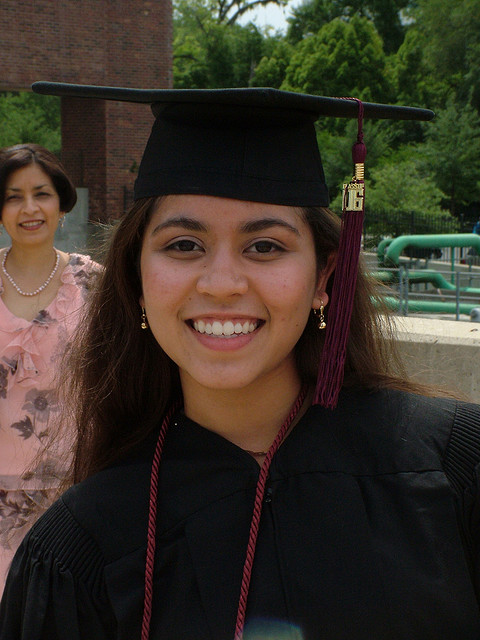
Then Mario had a special message for Kyla. She was being awarded a $20,000 college scholarship from The Horatio Alger Association. (See article.) That was a cool moment. So cool, that it inspired UMass Boston Chancellor, Dr. Keith Motley, to create a 4 year scholarship, given annually, to attend UMass Boston for a Mass. student that has experienced homelessness.
Photo title is "College Graduation Smile" by portorikan via Creative Commons.
Labels:
college,
education,
homeless,
Horatio Alger Association,
scholarship
Thursday, September 9, 2010
To give or not to give? by Abby Strunk
A question I've been asked frequently since taking on the role of Executive Director of Street Sense is, "What should I do when I see a homeless person?" Many people reference a memory from their childhood when they were told by their mother or father not to give money because doing so enables the person. In other words giving a dollar might contribute to that individual remaining on the streets. I disagree. But, I also do not believe that giving money to a homeless person is the only action one can take.
While I've never been homeless myself, I don't know anyone who wants to or likes to feel invisible. But, that's how many of our homeless neighbors feel. I once heard a homeless man say, "I feel like a ghost, like people can see right through me."
One of my favorite yoga authors, Judith Lasater, suggests a mantra for daily living: I will do what I can in response to what is needed here. I recommend using this mantra as a guide when deciding how you can help someone who is struggling. Simply ask yourself, "What is it that I can do in response to what is needed here?" Can I carry granola bars in my bag to give out to someone who needs it? Can I ask a homeless person if I can buy them a cup of coffee or tea? Can I sacrifice a half-hour of my time to buy someone lunch?
Can I make a commitment to give my time, money or resources to an organization that is making a positive difference?
All of these are incredibly noble efforts. What is almost certain is that the next time you pass someone who is living on the streets, you can make eye contact, say "hello," ask how he/she is doing and wait to hear a response. Give someone who is homeless the gift of being seen and heard.
I draw inspiration from the words of Dr. Martin Luther King Jr. when he spoke at the National Cathedral just before his death. He said: "We are tied together in the single garment of destiny, caught in an inescapable network of mutuality. And whatever affects one directly affects all indirectly. For some strange reason, I can never be what I ought to be until you are what you ought to be. And you can never be what you ought to be until I am what I ought to be."
Please do what you can in response to what is needed.
Abby Strunk is the Executive Director of Washington, D.C.'s Street Sense, a 16-page biweekly street newspaper that offers economic opportunities for people experiencing homelessness through a newspaper that elevates voices and encourages debate on poverty and injustice.
Labels:
Abby Strunk,
Giving,
homeless,
Martin Luther King Jr.,
Street Sense
Subscribe to:
Posts (Atom)