
Wednesday, February 16, 2022

Homelessness in U.S. History


Many people have told me that there was not really a history of homelessness in the U.S., that this is a modern phenomenon beginning in the 1980s when the issue became so visible at unprecedented levels. But that is simply not true. Historian Ken Kusmer, author of Down And Outreminds us that we have had periods of homelessness in the past besides the well-known homelessness conditions of the Great Depression. In the 1980s we saw the effects of the shift from a manufacturing economy to a service/information economy (think of the rust belt for example). Kusmer describes a similar shift in the late 1880s when the nation moved from an agricultural economy to a manufacturing one. Both shifts meant upheaval for many workers that were left extremely vulnerable and, in worst cases, without a home. That left many people more vulnerable, and when combined with illness, injury, or strained social networks, the combination became a type of homelessness cocktail.

The stigma of having no home in that era, true today as well, is evident in Stephen Crane’s, “An Experiment in Misery,” which first appeared as an article in the New York Press (1894) and was later released as a book (1896).

He was going forth to eat as the wanderer may eat, and sleep as the homeless sleep. By the time he had reached City Hall Park he was so completely plastered with yells of “bum” and “hobo,” and with various unholy epithets that small boys had applied to him at intervals, that he was in a state of the most profound dejection.

War veterans have also been overrepresented among homeless people in American history. In the modern era, Vietnam veterans and veterans from the Iraq and Afghanistan wars may return with psychological and physical scars that extend the war beyond the battlefield, can lead to drug addiction and/or isolation from others, and for many, homelessness. This was true in prior wars.  A number of Civil War veterans also became homeless. Many were accustomed to traveling, living on the road as soldiers, and once the war ended in 1865 continued doing that either for economic reasons, afflicted by the war, or because they had nothing to go back to.

Fortunately politcal will has galvanized in the past 2 decades. Members of the political right and left in Congress deserve credit for coming together to support initaitives to support homeless veterans. Besides the political will to support veterans, research has proved some policy tools extremely effective (e.g., HUD-VASH vouchers). The result has been a steady and impressive decline among veterans experiencing homelessness. 

Why is an historical lens on homelessness important? There is a belief that homelessness is tied to modern times and economic recession. When the economy declines, some people are left homeless. It seems logical enough. But history shows us that this is not the case. Other forces are at play. In the early 1980s when Ronald Regan took office, the economy was poor  and homelessness was becoming visible in ways that were new, including an upsurge of homeless families. When the economy recovered and soared for many in that decade, rates of homelessness continued to rise. It rose through the Bill Clinton 1990s, during the dot.com explosion, and it rose through the economic downturns of 9/11 and the Great Recession of 2008–2009 during George W. Bush’s presidency. Some populations saw rises in homelessness during the Obama and Trump eras, while some (like veterans) continued to decline. The latest federal data indicates rates of homelessness are increasing slightly due to COVID.

Today our challenge is not to get stuck with the same old models, not play the blame game across ideological sides, and not to assume a rising tide will lift all boats. Instead we need to take a holistic, systemic look at homelessness. We need to collaborate across federal departments more than ever, and across sectors. And through our work we need to always maintain a humanistic—especially historic—perspective.

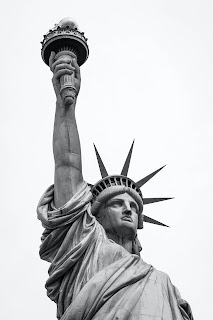
When we think of ourselves as Americans at our best, we think of the inscription at the base of the Statue of Liberty, in Emma Lazarus’s 1883 poem “The New Colossus,” from which our organization derives its name. It’s a vision of America symbolically reaching out to those in need of comfort and offering welcome, and, implied, a home.

Give me your tired, your poor, your huddled masses yearning to breathe free, the wretched refused of your teeming shore. Send these, the homeless, tempest-tost to me, I lift my lamp beside the golden door!


A version of this article by the author first appeared in the
Valley Advocate.

Wednesday, May 13, 2015

#WithTheseHands Photo Campaign


Have you heard of the #WithTheseHands campaign?
It is part of Give US Your Poor’s initiative to raise awareness of the homeless veterans and their families living around the nation. With These Hands is a photo campaign inspired by the final verse of the Bruce Springsteen song, “My City of Ruins.” It is designed to engage us all to be part of the solution to ending veteran homelessness, whether you are a veteran or civilian, homeless or housed.
The #WithTheseHands campaign already includes musicians such as Jon Bon Jovi, Mario Frangoulis, and Steve Earle – not to mention all the amazing average Joe’s and Jane’s who have also submitted their photos!  It is constantly growing!
Based on the 2014 Homeless Census there are 49,933 homeless veterans nationwide. The good news is that the nature and scope of the problem makes this solvable. Veteran homelessness is down by 33% since 2010. Cities around the country have started to report that they have ended chronic veteran homelessness, look to New Orleans as a perfect example.
Efforts have even been made at the federal level. President Obama declared a plan to end veteran homelessness by the end of 2015. First Lady Michelle Obama has partnered with the U.S. Housing and Urban Development Department on the Mayors Challenge to End Veteran Homelessness. This is a call to action for mayors to make a commitment to ending veteran homelessness in their cities in 2015. Progress is being made.
If you want to show your support for the fight to end veteran homelessness you can participate in the #WithTheseHands campaign. All you have to do is tweet or post to Facebook a photo of yourself showing your hands with the hashtag #WithTheseHands to @GiveUSYourPoor. There is no right or wrong way to hold your hands – be creative!
Show your support to ending veteran homelessness in four easy steps:
  • Snap it
  • Tag it with #WithTheseHands
  • Post it to @GiveUSYourPoor
  • Share it with friends


Together we can end veteran homelessness!

Monday, March 2, 2015

Homeless Census 2015 - Boston

The Give US Your Poor team had the honor of volunteering at the 35th Annual Point-In-Time Count in Boston on February 25th, 2015. This homeless census occurs each year as part of the Department of Housing and Urban Development’s (HUD) requirement for communities to conduct counts of sheltered and unsheltered homeless individuals.

In Boston over 300 volunteers gathered at City Hall at 8:30pm to form into groups and zones. Mayor Walsh spoke to the energized crowd as everyone zipped up their jackets and prepared for the cold. It was such a moving experience to stand there with so many other volunteers all interested in helping the homeless residents of Boston. Our group of 8 was included graduate students, finance big-wigs, and a MBTA (Boston public transportation) transit police officer. It was such a diverse group of people all there for one purpose. Around 9pm we headed underground to canvas our assigned area, the Green and Blue subway stations. At each stop we would get off the subway and walk around the station checking in each elevator, corner, and hallway for individuals that did not have a place to go that night. By the end of the night we found 15 people who had set up camp for the night. We engaged with each one asking for as much information as they felt comfortable providing off the HUD questionnaire. We also asked if they would be interested in transportation to a shelter or hospital depending on their needs. We had a couple takers and others that were content with staying put. Due to the overwhelming winter Boston has had, the MBTA has been particularly understanding by allowing people to stay warm and dry in the stations. Our night ended around 1am. And as the Mayor pointed out before, we were all especially grateful to go home.

If I could describe the night in one word it would be unforgettable. It was a moving experience to engage in conversation with a person that everyone else was blindly walking past. To hear someone’s story really changes your perspective. I urge everyone to sign up to volunteer next year.

The picture includes part of our group and Give US Your Poor's executive director John McGah getting up to speed. 

Andrea

Monday, December 15, 2014

Give US Your Poor's newest member: Andrea Locke

I write today as the newest member of the dedicated Give US Your Poor team.  My name is Andrea Locke and I am joining as an AmeriCorps VISTA mem
ber. Before I started last month I had the opportunity to travel to Atlanta, GA for AmeriCorps orientation. On my way to Atlanta it felt so appropriate that as I flipped through the Delta Sky Magazine that I would come upon an article with the opening sentence: “In 2013, Pew Research Center ranked 10 occupational groups by perceived value to society. Not surprisingly, the military topped the list, with 78 percent of U.S. adults saying that America’s armed forces contribute ‘a lot’ to the country’s well-being.”

This is great news, but as Chris Clayton’s article titled “Opening Doors” continues, it highlights the disconnect between what he calls ‘our cheerleading and the reality facing many military members and veterans.’ Clayton chose to focus his article on the problems and solutions for veterans transitioning back to civilian life by way of employment. Raising our attention to staggering figures such as the 722,000 unemployed veterans in the U.S. in 2013, the 9% unemployment rate among veterans having served from September 2001 to today, and the 250,000 service members that enter civilian life each year.

I acknowledged the severity of these figures as I flew South over New York and the Appalachian Mountains.  However, it also made me think ahead to my upcoming start at Give US Your Poor and another subset of veterans returning home. Those coming home to their country, yes, but not home to a roof over their heads. In 2013 there were 50,000 homeless veterans on any given night, and 29 of every 10,000 veterans are homeless. All hope is not lost, in 2009 the Obama Administration committed to ending veteran homelessness in the U.S. by the end of 2015. And since 2010 the number of homeless veterans has gone down by 33%. I am looking forward to my new role at Give US Your Poor and dedicating myself to ending veteran homelessness once and for all; by putting every soldier (society’s number one valued occupation) coming home to the U.S. into a home of brick and mortar. 

The orientation was a great success and truly instilled a sense of pride in all of us as VISTAs, as Volunteers In Service To America, with the overarching goal of eradicating poverty. I have also learned valuable tools and connections to hit the ground running now that I am back in Boston.
Prior to dedicating myself to Give US Your Poor I grew up in Upstate New York on Seneca Lake. I continued on to study history & political science at Warren Wilson College in Asheville, NC. Most recently, I graduated with a Master’s of Science in European Affairs from Lund University in southern Sweden. More personally, I love being outdoors, hiking, and exploring, whether that be internationally or around the block. Having just moved to Boston I have a lot of exploring to do on the weekends!

I am looking forward to making meaningful connections with all of you in the coming months. Feel free to contact me anytime.


Andrea Locke

Friday, September 5, 2014

Excerpt: Thank You For Your Service

This excerpt from Thank You for Your Service by David Finkel first appeared and was taken from http://www.npr.org/books.
PROLOGUE

You could see it in his nervous eyes. You could see it in his shaking hands. You could see it in the three prescription bottles in his room: one to steady his galloping heart rate, one to reduce his anxiety, one to minimize his nightmares. You could see it in the screensaver on his laptop — a nuclear fireball and the words FUCK IRAQ — and in the private journal he had been keeping since he arrived.

His first entry, on February 22:

Not much going on today. I turned my laundry in, and we're getting our TAT boxes. We got mortared last night at 2:30 a.m., none close. We're at FOB Rustamiyah, Iraq. It's pretty nice, got a good chow hall and facilities. Still got a bunch of dumb shit to do though. Well, that's about it for today.

His last entry, on October 18:

I've lost all hope. I feel the end is near for me, very, very near. Darkness is all I see anymore.

So he was finished. Down to his final hours, he was packed, weaponless, under escort, and waiting for the helicopter that would take him away to a wife who had just told him on the phone: "I'm scared of what you might do."

"You know I'd never hurt you," he'd said, and he'd hung up, wandered around the FOB, gotten a haircut, and come back to his room, where he now said, "But what if she's right? What if I snap someday?"

It was a thought that made him feel sick. Just as every thought now made him feel sick. "You spend a thousand days, it gets to the point where it's Groundhog Day. Every day is over and over. The heat. The smell. The language. There's nothing sweet about it. It's all sour," he said. He remembered the initial invasion, when it wasn't that way. "I mean it was a front seat to the greatest movie I've ever seen in my life." He remembered the firefights of his second deployment. "I loved it. Anytime I get shot at in a firefight, it's the sexiest feeling there is." He remembered how this deployment began to feel bad early on. "I'd get in the Humvee and be driving down the road and I would feel my heart pulsing up in my throat." That was the start of it, he said, and then Emory happened, and then Crow happened, and then he was in a succession of explosions, and then a bullet was skimming across his thighs, and then Doster happened, and then he was waking up thinking, "Holy shit, I'm still here, it's misery, it's hell," which became, "Are they going to kill me today?" which became, "I'll take care of it myself," which became, "Why do that? I'll go out killing as many of them as I can, until they kill me.

"I didn't give a fuck," he said. "I wanted it to happen. Bottom line — I wanted it over as soon as possible, whether they did it or I did it."

The amazing thing was that no one knew. Here was all this stuff going on, pounding heart, panicked breathing, sweating palms, electric eyes, and no one regarded him as anything but the great soldier he'd always been, the one who never complained, who hoisted bleeding soldiers onto his back, who'd suddenly begun insisting on being in the right front seat of the lead Humvee on every mission, not because he wanted to be dead but because that's what selfless leaders would do.

He was the great soldier who one day walked to the aid station and went through the door marked COMBAT STRESS and asked for help and now was on his way home.

Now he was remembering what the psychologist had told him: "With your stature, maybe you've opened the door for a lot of guys to come in."

"That made me feel really good," he said. And yet he had felt so awful the previous day when he told one of his team leaders to round up everyone in his squad.

"What'd we do now?"

"You didn't do anything," he said. "Just get them together."

They came into his room, and he shut the door and told them he was leaving the following day. He said the hard part: that it was a mental health evacuation. He said to them, "I don't even know what I'm going through. I know that I don't feel right."

"Well, how long?" one of his soldiers said, breaking the silence.

"I don't know," he said. "There's a possibility I won't be coming back."

They had rallied around him then, shaking his hand, grabbing his arm, patting his back, and saying whatever nineteen- and twenty-year-olds could think of to say.

"Take care of yourself," one of them said.

"Drink a beer for me," another said.

He had never felt so guilt-ridden in his life.

Early this morning, they had driven away on a mission, leaving him behind, and after they'd disappeared, he had no idea what to do. He stood there for a while alone. Eventually he walked back to his room. He turned up his air conditioner to high. When he got cold enough to shiver, he put on warmer clothes and stayed under the vents. He packed his medication. He stacked some packages of beef jerky and mac 'n' cheese and smoked oysters, which he wouldn't be able to take with him, for the soldiers he was leaving behind and wrote a note that said "Enjoy."

Finally it was time to go to the helicopter, and he began walking down the hall. Word had spread through the entire company by now, and when one of the soldiers saw him, he came over. "Well, I'll walk you as far as the shitters, because I have to go to the bathroom," the soldier said, and as last words, those would have to do, because those were the last words he heard from any of the soldiers in his battalion as his deployment came to an end.

His stomach hurt as he made his way across the FOB. He felt himself becoming nauseated. At the landing area, other soldiers from other battalions were lined up, and when the helicop ter landed, everyone was allowed to board except him. He didn't understand.

"Next one's yours," he was told, and when it came in a few minutes later, he realized why he'd had to wait. It had a big red cross on the side. It was the helicop ter for the injured and the dead.

That was him, Adam Schumann.

He was injured. He was dead. He was done.

Excerpted from THANK YOU FOR YOUR SERVICE by David Finkel, published in October 2013 by Sarah Crichton Books, an imprint of Farrar, Straus and Giroux, LLC. Copyright 2013 by David Finkel. All rights reserved. 

Tuesday, May 20, 2014

"On Homelessness" by Frank Calisi


This is my third time being homeless. I do not like being in a shelter. It is a daily struggle. I must follow the rules and yet my fellow vets make me feel conflicted about what is right. It isn’t always easy to follow what your instincts tell you is the right path. I currently reside in the NECHV. It’s a dry shelter on paper, although many here do still drink. It’s a shell game as to who gets caught – who is more drunk than the next. I’ve only drank a few times. It is nerve wracking. I do not enjoy it – at least not here. I also go to AA meetings. To drink is like going against the grain of what I know is right, what is expected of me and what I feel like doing. I know deep inside that it is therapeutic to have these constraints. This place is a microcosm of the real world except that we are all veterans. At times, it’s like walking on eggshells around here. Don’t rock the boat. That’s my inner self talking to me. Do your KPS, deck duty, make all medical and social appointments. There’s a sub drug culture here, too. Another one of my downfalls – just the thought of being thrown out scares me into being on the straight and narrow.

I have been here five months. It’s time to move on. Yes, I have applied to various apartments. I have been rejected by three because of my past record. Today I looked at a market rate one in Lynn – kinda small, 50’s style, old, but solid. They accepted my application but I want to still look. Don’t want to jump into anything. It’s scary and hard to transition from one institution to being all free. These walls play tricks on my mind. I guess you could safely say that I am institutionalized. I’ve been doing the routine. I have become dependent in many ways on this institution. Transitioning to an apartment is scary.

I have been accepted to the bridges program. It does just that – gives you a way back onto the mainland of society. I get an outside caseworker who will visit me for 9 months, who will help make sure I fit into the community I will live in. Mental health, sobriety and physical well-being are my goals. I will follow-through. This English class keeps my mind in check. I am grateful for it. It allows me to pass the time constructively. Yes, you can say it’s therapeutic. Just writing this paper right now is therapeutic. It gives me room to write honestly and perhaps to see the virtue in life. “It’s a journey,” I heard one of the other students say. I feel like my journey stretches out in front of me into thousands of miles  -  I feel like I have covered maybe a few hundred so far. I must keep one foot in front of the other, walk the straight and narrow line of this life.


Frank Calisi is a U.S. veteran and a resident at the New England Center for Homeless Veterans, where he is a member of the Glass House Shelter Project, a writing partnership with the University of Massachusetts Boston.

Thursday, September 5, 2013

Housing is Healthcare


Nowhere to Pee

Did you ever have a moment when something you already understood intellectually suddenly lands on an almost cellular level?

Last Thursday, a conversation at work did that, for me. "Robert" who endured chronic homelessness for nearly three years, was recently successfully referred into a permanent supportive housing program. He had come by our agency, Bethesda Cares, to chat, to report on his tremendous and rapid personal progress.

"I am so glad. I peed for, like, 45 minutes yesterday," he said, "because I finally could."

I thought he meant he was grateful for the "luxury" of ready-access to the toilet in his new apartment.

That "luxury" wasn't it, though. Robert was talking about the actual reason having a toilet matters: his health.

Robert has congestive heart failure, a condition that means his heart is not pumping adequately to keep his kidneys effectively processing waste. Thus, his body builds up fluids, swelling his ankles and legs. A free clinic had supplied him with diuretics, crucial for alleviating his symptoms. Yet Robert could not use his life-saving medication.

Think about it, Reader.

Diuretics, while you are living on the street. No option to just run to the bathroom when you feel the need.

Now housed, Robert has a bathroom with a medicine cabinet, and can finally properly store and take his meds.

Housing Is, In Fact, Healthcare

We all share same three-legged stool of basic needs we must meet for human survival: food, shelter, clothing. Take one leg away, and the stool tumbles. For the purposes of this post, let's look at existence without "shelter."

"Housing is healthcare" is a mantra around Bethesda Cares. Our work centers on housing as the stabilizing factor for recovery, health, and ultimately, survival. It's a model broadly known as "Housing First."

The people we serve, living unsheltered and homeless, are society's most medically vulnerable. They are routinely exposed to the hottest nights, the coldest days, blizzards, downpours, the occasional derecho. They suffer frostbite; multiple conditions from sleep deprivation; their cuts and scrapes are prone to infection; they are at risk of dehydration year-round. And yes, some of them "self-medicate" by drinking themselves into unconsciousness

All that is, of course, in addition to the ordinary illnesses and conditions we each encounter as we age.

How is the homeless woman with diabetes supposed to refrigerate her insulin? The man with high cholesterol, but no kitchen, to cook himself low-fat meals? People coping with both the frenetic uncertainty of life on the street, and with constant exposure to the natural elements are at abnormally -- and avoidably -- high risk of physical suffering, and premature death from treatable causes.

It's a disgrace.

You Don't Need to Be an Economist to Do the Math

If the humanitarian aspects of housing don't move you, consider the economics of "housing as healthcare." They are stark.

Where do people experiencing homelessness go for emergency care? To the nearest hospital ER, of course, maybe ferried there by a local rescue squad who intervened. In fact, people experiencing long-term homelessness are among the highest consumers of costly emergency medical interventions. A hospital must, by law, "stabilize" a person suffering an emergency even if the person cannot pay. The hospital then absorbs that expense.

(I'm just spitballin' here, but you think maybe hospitals pass on those costs on to other consumers, like, say, your insurance company?)

So after perhaps an overnight stay, and tens of thousands of dollars of services later, the patient is released... back onto the streets. Maybe the condition that sent him to the ER is permanently alleviated. Probably not. Regardless, returning to sleeping on a park bench will not speed anyone's recovery.

Even in pricey Montgomery County, Maryland, the cost of housing a person experiencing long-term homelessness is thousands of dollars less, per annum, than allowing that person to remain homeless.
Any third-grade readers out there get that mathematical calculation?

No?

Any adults?

One Other Wrinkle

Emergency service costs are incurred only if someone seeks treatment; for people living unsheltered, that is not always the case. Why wouldn't someone want to go to a free clinic or check in to a hospital, if need be?

You ever see someone you think is experiencing homelessness, because he carts around a lot of "stuff"? That's everything he owns. Those bags and shopping carts might look like they are filled with detritus, but they are items of no lesser a personal value than are our own photo albums, laptops and favorite coffee mugs.

When you and I leave our places of residence, we lock the doors and expect our belongings to be there on our return. A person living at a bus stop, however -- I refuse to call a bus stop a "home" -- knows that his stuff may have vanished by the time he returns from the ER, either into a dumpster, or scavenged by someone else in need.

Seeking treatment is not a slam-dunk of a choice.

In the End

The reasons that people experiencing homelessness are tremendously medically vulnerable are both physical and psychological, the factors quite complex.

But there is that solution to the equation: Housing as healthcare. I have long understood that. Now I get it, too.

Amy Freeman wrote this article.  She is a staffer at Bethesda Cares, the organization leading the 100,000 Homes Campaign in Bethesda, MD.  100,000 Homes Campaign is a partner of Give US Your Poor in the American Music Project: Voices for Veterans. Amy recently reflected on an experience that drove home the importance of housing in personal terms. (This piece was originally published at HuffingtonPost.com and again on the 100,000 Homes website. You can view the original story here.)

Monday, July 29, 2013

Mario Frangoulis Concert

 
On June 6th Give US Your Poor partnered with world renowned Greek Tenor Mario Frangoulis at his concert at the Berklee Performance Center in Boston.  Frangoulis has been a friend and supporter of Give US Your Poor for many years.  He has performed in benefit concerts for Give US Your Poor in the past, as well as appearing on our album.

At the show we set up shop in the lobby of the venue.  We were there to spread awareness about our new initiative (American Music Project: Voices for Veterans) which aims to engage musicians and their fans in the attempt to end veteran homelessness by 2015.  We were able to talk with over a hundred of Mario's fans about the issue of veteran homelessness. 

Mario put on a wonderful show, seamlessly weaving together classical and modern pop music.  The concert also featured beautiful performances by the Women of the World and the Berklee Balkan Choir.  Throughout the show, Mario wore his heart on his sleeve, speaking about the recent tragedy in Boston and poverty among the children of the world. Mario also spoke about his work with Give US Your Poor and his friendship with the organizations director John McGah.

After the show we were able to go backstage and talk briefly with Mario. Mario is as friendly and charming in person as he is on-stage.  He kindly welcomed us and thanked us for what were doing to end homelessness.  He also posed for a photo with some of the Give US Your Poor staff.  Mario has been a great friend to our organization for several years now and we hope to continue that relationship for years to come.


Tuesday, February 12, 2013

Music as a Tool for Healing

Image from makingmusicmag.com
The New Directions Choir is an acapella group that sings in a range of styles and is comprised of men and women who have served in the United States Military.  Besides their love of music and their military service, one other trait  draws them all together.  All of the members have experienced homelessness.  According to George Hill, the choir’s director, the group hopes that through music they will be able “to let veterans who may be suffering know that there is hope for them.”  Through music the New Directions Choir wants to help others heal just as music helped them heal their own wounds.

The concept of music as a means for healing has been around since the days of Ancient Greece.  Plato once spoke on the mystical power of music saying:

Music is a moral law. It gives a soul to the universe, wings to the mind, flight to the imagination, a charm to sadness, and life to everything

While abstractly seen as a way of soothing the soul for centuries, music wasn’t formally recognized by western medicine as a means of healing until the 1900’s.  During this time musicians played in hospitals to help heal WWI and WWII veterans suffering from physical and mental trauma.  The doctors noticed physical and mental improvement after these visits, leading them to request that the hospital to hire musicians.  Since then music therapy programs have grown in strength and popularity.

One area where music therapy has been shown to be particularly useful is with veterans, like the members of New Directions Choir.  Due to the high stress and traumatic situations they may experience during their tours, soldiers are highly susceptible to certain mental conditions.  According to the National Council for Community Behavioral Healthcare, mental illness is the second-largest illness area effecting veterans from the Iraq and Afghanistan wars.  There is a wide range of different mental illness that affect veterans, but the most prevalent of those are depression, anxiety, and PTSD. 

Mental illnesses, beyond just being a health concern, can also affect a veteran’s family and work life.  In severe cases, the mental illness can make it almost impossible for a person to make connections and form relationships with the people around them, leaving them in a state of social poverty.  This social poverty is huge risk factor for homelessness. 

Research has shown the music therapy is a helpful tool in combating the social poverty that often leads many veterans to become homeless.  In a study in the Tennessee Medicine Journal, researchers found that music therapy was useful in “ensuring trust and moving individuals from isolation to community so that services can be provided” among a homeless veteran population.  Music often allows people to connect and communicate with others in a way that they are unable to simply with words. 

Bob Marley once said, "One good thing about music, when it hits you, you feel no pain."  While music therapy may not, in fact, take away all of a homeless soldiers' pain, it may ease the hurt and make it easier to connect with the people around them.


Wednesday, January 30, 2013

Breaking the 4-Minute Mile & Ending Veteran Homelessness


Marilyn Paul and David Peter Stroh of Bridgeway Partners in their coursework tell the story of the British competitive runner, Roger Bannister.  The story goes something like this:

For centuries runners had been trying unsuccessfully to break the 4-minute mile.  Most people believed (their mental model) that doing so was simply beyond the limits of human capability and may, in fact, be unhealthy for humans. 

But they forgot to tell Roger Bannister it couldn't be done.  He focused his energies and preparation in meeting that very goal.  Race after race, he kept getting faster and closer to the breaking the 4-minute mile.

On May 6th, 1954 at Oxford University, he did what what experts for centuries had said was not possible: he broke the 4-minute mile.  In doing so he smashed the mental barrier that said, "Impossible."

But perhaps even more remarkable, just 46 days later, the mark was broken again by another runner.  Since 1954 the 4-minute mile mark has been surpassed 1,192 times and counting.

It's a remarkable example of not listening to the experts when you believe something is possible.  It's also an example of the Law of Attraction.  As Matt Frazier wrote in his blog, "When you become certain of something, when every part of your makeup believes it because you focus on it every single day, something “magical” happens...When you have a clearly-defined purpose, a mission, and when you live every moment in a state of certainty that you’ll achieve it...you pay special attention things that help you achieve what you’re after, things you otherwise would have never noticed."

It reminds us too that so many of our limits are perceptions.

I believe ending veteran homelessness is a 4-minute mile.  It is within our grasp.  We see the path, we just need to execute.  The political will is in place like never before thanks to lessons from Vietnam in how we treat America's war veterans, and best practices in combining housing vouchers with support services (whether treating mental, physical, or other issues) are working.

And once veteran homelessness is ended, we might just say, "Hmm. We did it.  Turns out it was possible.  Now what?  How about we end, say, youth homelessness next..."


Sunday, December 16, 2012

A Woman Sings a Song for a Soldier Come Home (a poem by Wallace Stevens)


The wound kills that does not bleed.
It has no nurse to kin to know
Nor kin to care.

And the man dies that does not fall.
He walks and dies. Nothing survives
Except what was,

Under the white clouds piled and piled
Like gathered up forgetfulness,
In sleeping air.

The clouds are over the village, the town,
To which the walker speaks
And tells of his wound,

Without a word to the people, unless
One person should come by chance,
This man or that,

So much a part of the place, so little
A person he knows, with whom he might
Talk of the weather-

And let it go, with nothing lost,
Just out of the village, at its edge,
In the quient there.

Wallace Stevens was a poet born in Reading, PA in 1879 and who died in Hartford, CT in 1955.  This poem is taken from the book, The Palm at the End of the Mind: Selected Poems and a Play by Wallace Stevens (Vintage Books, 1972).  Robert Coles turned me on to Wallace Stevens.  This poem, which I found yesterday in a Western Mass. bookstore, was published in 1946.

Monday, October 22, 2012

Collaborating Across the System to End Homelessness

Dr. Jim O'Connell is founding physician and president of the Boston Healthcare for the Homeless Program.  He has long been a practitioner serving homeless people in Boston and a local and national advocate, writer and speaker advancing our thinking in how the nation addresses homelessness.  I recently came across this quote by Jim:

"The painfully obvious lesson for me has been the futility of solving this complex social problem solely with new approaches to medical or mental health care…I dream of writing a prescription for an apartment, a studio, an SRO, or any safe housing program, good for one month, with 12 refills.”

The quote because it rings true.  It immediately implies the interconnection of housing, mental health care and physical health care--in short, a systems view--in understanding homelessness.  If we think more about interconnections we also start seeing links to employment, to education, to food access.

It's all connected.  Our challenge is to see the interconnections, understand their interplay, and determine where best to intervene.

One way to do that is by applying "systems thinking."  That means mapping the interconnections (and interdependencies) to understand the structures of the "eco-system" that produces homelessness.  It means focusing not on blame of certain people/organizations but understating and addressing those structural forces.  ("Laziness," "choosing to be homeless," etc. doesn't explain epidemic homelessness.)  Systems thinking means looking for unintended consequences of our actions and continually testing ideas and assumptions.

And as much as anything, systems thinking (and the systems acting it leads to) requires collaboration, that is, practicing radical inclusion in the process, collecting different perspectives, listening (!), and reaching out across sectors, departments, and other boundaries.  As systems thinker, Paul Plotczyk, said to me, "Systems thinking is a team sport."  He's right.

The Dr. Jim O'Connell quote is taken from a paper he wrote titled, "The Need for Homelessness Prevention: A Doctor’s View of Life and Death on the Streets," (2007)

Most of my thoughts on systems comes from (stolen from?) a variety of systems thinkers I've met or read, chief among them is David Peter Stroh whom I regularly work with and learn from.  Poor systems thinking or articulation though is all me.

Monday, May 14, 2012

A Different Face of Homelessness – Ivy, Homeless in San Francisco (Part II of II) by Craig Wiesner

We hired a fantastic illustrator named Brian Bowes to bring Ivy and her story to life in pictures and he did a great job with black and white sketches and a beautiful color cover. We released the book in June 2011 and it has received two awards, the Moonbeam Book Award and the Children’s Literary Classics Award. We’ve been working since then to get the word out about the book. Unlike The Invention of Hugo Cabret or the latest Wimpy Kid book, this one’s been a bit harder to sell, actually quite a bit. When kids do read it, they love it. Adults too. Even my mother-in-law loved the book and she’s a pretty tough critic at 82!

Now we’re hoping to get teachers to use the book in their classrooms. We’ve just completed a chapter-by-chapter study guide where we map each chapter into standards, with a chapter summary, vocabulary preview, comprehension questions, active reading strategies, author’s craft/writing prompts, curriculum connections and awareness building promptings. The study guide was developed by Carol Beaumont, a teacher in the Palo Alto Unified School District. The study guide is being edited and readied for layout this month, though we’ll make it available in draft form to teachers who want to start using it right away.

Why should Ivy be in classrooms across the country? First, it is a darned good read! There’s drama, humor, adventure, and mystery wrapped in writing that keeps you turning the pages. Plus, there’s a girl or a boy like Ivy in most schools. Teachers, administrators, parents, and other children can’t make their schools truly inclusive if they have no idea of who is being left out. There are laws in place across the country to help provide homeless children with an equal education plus get them access to critical services to help them and their families transition from homelessness to a more stable life. Today there’s legislation before Congress, HR32, which would make it easier for homeless children and their families to register for and receive these services.

One of our dreams for Ivy was that she could become an advocate for children all around the country. To bring that dream to life we have Ivy blogging about homelessness through Summer Brenner’s writing. Check out Ivy’s most recent blog post about HR32:

http://www.reachandteach.com/s/hr32

We’ve also created a web page with a huge set of resources for learning about and taking action on the issue of homeless families and children.

http://www.reachandteach.com/ivy

We’re excited that Give US Your Poor has added Ivy Homeless in San Francisco to its web site’s bibliography. We will do whatever it takes to get her story, which represents the stories of millions of children and their families, out into the mainstream of American thinking. When Justin Bieber learned about the plight of the children at Whitney Elementary School in Las Vegas, a school with the highest homeless population in the state, he was so moved that he gave them $100,000 and put on a special holiday concert. Ellen DeGeneres, her viewers, and Target have been incredibly generous with that school. It will take much more than the wonderful generosity of people like Ellen and Justin for there to be fewer children like Ivy across America. It will take systemic change. We’re hopeful that Ivy will be one more spark for making that change real.

To read Part I of this post click here.

Craig Wiesner is the co-founder of Reach And Teach, a peace and social justice learning company.

Tuesday, April 10, 2012

A Different Face of Homelessness – Ivy, Homeless in San Francisco (Part I of II) by Craig Wiesner


People think they know the face of homelessness… the person from whom some avert their eyes as they walk along the street. I know that face. It is grizzled, gnarled, battered, and weary. It could be a man or a woman, black, white or brown, but the destructive force of life on the streets, in vehicles and in shelters leaves marks that are easy to spot. Many look away, to avoid the outstretched hand or escape having to share someone else’s suffering. Yet few walking down the street would avert their eyes from a cute little girl, a scruffy young boy, or a typical teen. Walking into any of America’s classrooms most of us can’t imagine that the boy sitting next to the class clown or the girl sitting near the teacher’s pet could be homeless. But they may very well be.

One out of 50 children in the United States will spend part of this year homeless. Whether they are in shelters, temporarily living with friends or relatives, living in cars, or at worst truly out on the streets, homeless children and families are more hidden. Another mostly invisible face of homelessness is LGBTQ youth. According to The National Gay and Lesbian Task Force (NGLTF), up to 40% of homeless youth are gay.

At Reach And Teach our mission is to “transform the world through teachable moments.” With 1.5 million children experiencing homelessness in the United States, what could we do to make an impact on this issue? In 2010 our friends at PM Press sent us a note about a book they thought we should consider publishing about a homeless San Francisco girl named Ivy. Author Summer Brenner had done some volunteer work at a shelter for women and children and their stories touched her and prompted her to create Ivy Homeless in San Francisco.

I read the new manuscript and fell in love with Ivy, her father Poppy, and an eccentric pair of siblings named Eugenia and Oscar Orr. Ivy and her father had been evicted from their artist loft apartment when Poppy fell on hard times and couldn’t pay the rent. As someone who lived through the dot-com bubble, where San Francisco rents went through the roof, and average folks and small businesses were being tossed out onto the streets left and right, I could relate to this story! Ivy and Poppy ended up sleeping in Golden Gate Park and eating their rare meals at a soup kitchen. When Ivy took a tumble and got hurt, the police stepped in and it looked like Ivy would be taken away from her father. But then the Orr’s stepped in and an amazing adventure ensued.

(Part II of this blog entry will be posted shortly.)

Craig Wiesner is the co-founder of Reach And Teach, a peace and social justice learning company.

Photo found at Orlando Sentinel here.

Thursday, March 15, 2012

"Creating love out of the broken pieces" - Quote from Bruce Springsteen

"Now, I always thought that in our fall from Eden, besides the strains of physicality and the bearing of earthly burdens, our real earthly task was that an unbridgeable gap or a black hole was opened up in our ability to truly love one another. And so our job here on earth and the way we regain our divinity, our sacredness and our general good standing is by reconstructing love and creating love out of the broken pieces that we’ve been given. That’s all we have of human promise. That’s the way we prove ourselves in the eyes of God and facilitate our own redemption.”

Bruce Springsteen (Induction of Jackson Browne, Rock and Roll Hall of Fame, 2004)


Photo from Time Life website.

Monday, February 27, 2012

What the Horatio Alger Scholarship Meant to Me by Nicholas Timm

The Horatio Alger Association has one of the nation's largest college financial aid programs in the country, the Horatio Alger National Scholarship Program. It is the only major scholarship effort that specifically assists high school students who have faced and overcome great obstacles [including homelessness] in their young lives. While many aid programs are directed primarily to recognizing academic achievement or leadership potential, the Horatio Alger program also seeks students who have a commitment to use their college degrees in service to others.

The National Scholarship Program is awarded to eligible students in all fifty states, the District of Columbia, and Puerto Rico. National Scholars receive an all-expenses paid trip to Washington D.C. during the spring of their senior year to participate in the National Scholars Conference.

To receive the Horatio Alger Scholarship is a great honor to me. Out of thousands of applicants, I was 1 of 104 young people chosen to receive the award. Receiving it was a blessing. I am truly thankful for all the opportunities that the association has presented to me.

Growing up, I didn’t have the motivation and dedication I have today. I was abandoned by my parents and grew up with a crazy woman. Some people say I should thank God for my hardships. I agree, because these experiences made me stronger as an individual.

At the conference in Washington, D.C, I had life-changing experiences. Some of which are hard to explain. However, to meet all 103 other people with similar stories as mine, was disappointing (in that they had to go through such hardships) but also satisfying. I knew if they got through their hardships, then I can get through mine. We all motivate each other to succeed. We still talk to each other through social networking when we are feeling down or stressed.

Winning this scholarship gave me another family. Another group of people I can count on to support me, to guide me, and to motivate me through difficult times. It is with great honor that I accept the title “Horatio Alger National Scholar”.

Nicholas Timm is a Horatio Alger National Scholar and currently attends Wentworth Institute of Technology in Boston.  In 2010 and 2011 Give US Your Poor partnered with the Horatio Alger Association to reach out nationally to high school students that had experienced homelessness to apply for college scholarships.  Nicholas now volunteers for Give US Your Poor; this essay first appeared on the Horatio Alger blog in a similar form.

Tuesday, November 22, 2011

On Meddling (Part 2 of 2) by Lewis Thomas


Lewis Thomas was a well known biologist and essayist who wrote the following piece on meddling with complex systems in 1974. This essay is divided into 2 blogs.  To read part 1 click here.

These were the classical examples of medical intervention in the prescientific days, and there can be no doubt that most of them did more harm than good, excepting perhaps the incantations.

With syphilis, of course, the problem now turns out to be simple. All you have to do, armed with the sure knowledge that the spirochete is the intervener, is to reach in carefully and eliminate this microorganism. If you do this quickly enough, before the whole system has been shaken to pieces, it will put itself right and the problem solves itself.

Things are undoubtedly more complicated in pathological social systems. There may be more than one meddler involved, maybe a whole host of them, maybe even a system of meddlers infiltrating all parts of the system you're trying to fix. If this is so, then the problem is that much harder, but it is still approachable, and soluble, once you've identified the fact of intervention.

It will be protested that I am setting up a new sort of straw demonology, postulating external causes for pathological events that are intrinsic. It is not in the nature of complex social systems to go wrong, all by themselves, without external cause? Look at overpopulation. Look at Calhoun's famous model, those crowded colonies of rats and their malignant social pathology, all due to their own skewed behavior. Not at all, is my answer. All you have to do is find the meddler, in this case Professor Calhoun himself, and the system will put itself right. The trouble with those rats is not the innate tendency of crowded rats to go wrong, but the scientists who took them out of the world at large and put them into too small a box.

I do not know who the Calhouns of New York City may be, but it seems to me a modest enough proposal that they be looked for, identified, and then neatly lifted out. Without them and their intervening, the system will work nicely. Not perfectly, perhaps, but livably enough.

We have a roster of diseases which medicine calls "idiopathic" meaning that we do not know what causes them. The list is much shorter than it used to be; a century ago, common infections like typhus fever and tuberculous meningitis were classed as idiopathic illnesses. Originally, when it first came into the language of medicine, the term had a different, highly theoretical meaning. It was assumed that most human diseases were intrinsic, due to inbuilt failures of one sort or another, things gone wrong with various internal humors. The word "idiopathic" was intended to mean, literally, a disease having its own origin, a primary disease without any external cause. The list of such disorders has become progressively shorter as medical science has advanced, especially within this century, and the meaning of the term has lost its doctrinal flavor; we use "idiopathic" now to indicate simply that the cause of a particular disease is unknown. Very likely, before we are finished with medical science, and with luck, we will have found that all varieties of disease are the result of one or another sort of meddling, and there will be no more idiopathic illness.

With time, and a lot more luck, things could turn out this way for the social sciences as well.

To view part 1 of this 2 part essay from 1974 click here.

Monday, November 14, 2011

On Meddling (Part 1 of 2) by Lewis Thomas


Lewis Thomas was a well known biologist and essayist who wrote the following piece in 1974.  In this essay, he reflects on the unintended consequences of trying to affect (or "meddle" with) any part of a complex system without first understanding the whole (as best you can).  Introduced to me by David Peter Stroh, it's a highly readable piece on systems thinking with indirect application to homelessness policy.

When you are confronted by any complex social system, such as an urban center or a hamster, with things about it that you're dissatisfied with and anxious to fix, you cannot just step in and set about fixing with much hope of helping. This realization is one of the sore discouragements of our century. Jay Forrester has demonstrated it mathematically, with his computer models of cities in which he makes clear that whatever you propose to do, based on common sense, will almost inevitably make matters worse rather than better. You cannot meddle with one part of a complex system from the outside without the almost certain risk of setting off disastrous events that you hadn't counted on in other, remote parts. If you want to fix something you are first obliged to understand, in detail the whole system, and for every large systems you can't do this without a very large computer. Even then, the safest course seems to be to stand by and wring hands, but not to touch.

Intervening is a way of causing trouble.

If this is true, it suggests a new approach to the problems of cities, from the point of view of experimental pathology: maybe some of the things that have gone wrong are the result of someone's efforts to be helpful.
It makes a much simpler kind of puzzle. Instead of trying to move in and change things around, try to reach in gingerly and simply extract the intervener.

The identification and extraction of isolated meddlers is the business of modern medicine, at least for the fixing of diseases caused by identifiable microorganisms. The analogy between a city undergoing disintegration and a diseased organism does not stretch the imagination too far. Take syphilis, for instance. In the old days of medicine, before the recognition of microbial disease mechanisms, a patient with advanced syphilis was a complex system gone wrong without any single, isolatable cause, and medicine's approach was, essentially, to meddle. The analogy becomes more spectacular if you begin imagining what would happen if we knew everything else about modern medicine with the single exception of microbial infection and the spirochete. We would be doing all sorts of things to intervene: new modifications of group psychotherapy to correct the flawed thinking of general paresis, transplanting hearts and aortas attached for cardiovascular lues, administering immunosuppressant drugs to reserve the autoimmune reactions in tabes, enucleating gummas from the liver, that sort of effort. We might even be wondering about the role of stress in this peculiar, "multifactorial," chronic disease, and there would be all kinds of suggestions for "holistic" approaches, ranging from their changes in the home environment to White House commissions on the role of air pollution. At an earlier time we would have been busy with bleeding, cupping, and purging, as indeed we once were. Or incantations, or shamanist fits of public ecstasy. Anything, in the hope of bringing about a change for the better in the whole body.

The "Meddling" image at top is by Mark Wilson.  If interested in T-shirts or hoodies with this design click here.

Thursday, September 15, 2011

Excerpt from How to Be a Homeless Frenchman (Part 2 of 2) by Paula Young Lee


The following is an excerpt from the book How to Be a Homeless Frenchman (2011).  Be aware there is some profanity in the excerpt.

Bob Dylan once said that a poem is a naked person. By that measure, there’s a lot of poetry in a homeless shelter. Every day, there were dozens of new arrivals, dredged in poverty and stinking of hopelessness, standing in the 6pm bed line hoping for a space. Per shelter rules, we had to strip down and take a shower before we could be processed for the evening. We were ordered to keep things “clean,” i.e. no drugs, no sex, and no staring. Get naked, and stop fidgeting! Grumbling yet pleased, we’d remove every stitch of clothing and hop across cold wet tiles in bare feet, swearing “fuck fuck fuckety fuck fuck! This fuckin’ water’s fuckin’ cold!”

“Yo’ mama!”

“Fuckety fuck fuck!”

In this place, it sounded like giggling.

Every day, it was a water ballet of homeless men raising their arms and twirling around, performing Nutcracker under the nozzles. As the clothes came off the usual social prejudices fell away, replaced by the quirky taxonomy of the despised. Young, old, short, fat, tall, bald, crippled, straight, bent, black, brown, and white. Nobody cared, except maybe the transvestites. Every man in the showers was butt-naked and frozen, shivering as flesh confronted water, cringing against the spray, delighting in the warmth, smiles spreading across faces, opening mouths the way that women open their mouths when putting on lipstick. A reflex. A kiss in the mirror. There was something sublime about the happy sounds we made once we started soaping up under the fizz and pop of hot water, singing “Row, row, row your boat, gently down the stream! Merrily, merrily, merrily, life is but a dream!”

And round and round it goes.

One day, good old Larry Chase, one of the unofficial regulars, stripped down to hairy pink, stuck his head under the spray, lathered up his beard, and started to sing. From behind the brouhaha of spittle and spray, his deep voice floated up, loud, confident and strong, an aboriginal calling to the mountaintops:

When I was just a little girrrrrl,

I asked my mother, What will I be?

Will I be pretty, will I be rich?

Here’s what she said to meeeee…”


Pause.


As if on cue, all the men joined in the chorus:


Queeeeeeeee, sera, sera,

Whatever will be, will be,

The future’s not ours to see,

Que sera, sera.


What will be, will beeeee!


Throatily we sang, with gusto and passion and glee, inner girls swishing invisible skirts, relishing the incomparable absurdity of being Doris for today. Naked men of every stripe and color, strangers stripped of every stitch -- bereft, barefoot, knowing nothing but the theme song to the Man Who Knew Too Much, recalling drowsy days of caramel when we were young and in love, asking our sweethearts, what lies ahead? Will we have rainbows and endless nights of bliss? Will we lie back, sighing, for another kiss? So many possibilities. Whatever will be, will be. Just not this.

But this is what we got. In four-part harmony.

Pure poetry.

How to Be a Homeless Frenchman by Paula Lee is now available to order online at www.harvardbooks.com, and a www.wellesleybooksmith.com via special order/phone only, 781-431-1160. An e-book Kindle version is currently available on www.amazon.com.  A related Give US Your Poor blog entry by Paula Lee can be found by clicking here.

Sunday, September 11, 2011

How to be a Homeless Frenchman (Part 1 of 2) by Paula Lee

"…for Chinese acupuncturists, all sickness is home sickness. It is what happens to a healthy body when the soul feels alone. Seeking solace elsewhere, the soul abandons the heart, the bones, and the body becomes full of holes. Sickness moves in, gets comfortable, and decides to stay. Homelessness happens to the body when the soul forgets it’s free to go."

                  -From How to Be a Homeless Frenchman, 2011

Everybody has a story. Even boring people have tales to tell. In times of quiet, confessions spill. “I’m afraid of giraffes.” “My wedding dress was a rental.” “I hoard lentils.” “I used to be homeless.” Excuse me? Not ‘homeless’ in an angst-ridden teenager way, but actually out on your ass and living hard in the street? On the one hand, it’s extraordinary that so many Americans have homes to lose in the first place. A testimony to modern laws that make it possible for ordinary citizens to own real estate. On the other hand, the loss of a house to debt, foreclosure, or random acts of God prompts few to celebrate the end of feudalism. But this is silly, you say. Homelessness isn’t about losing a house. It’s really about having no place to live.

Indeed.

“I’m homeless” is a statement of individual loss. “I have no place to live” is a confession of a deep and terrible truth. For it is true of all of us, going straight to the heart of what we like to claim is the “human difference,” a difference insisted upon for hundreds of years as the bedrock concept of civilization. We are the opposite of nature. We conquer and subdue. For we are superior to nature, and here is the iPod as proof! When humans become homeless on this engineered earth, they are as holes poking through the lovely fictions that make electric dreams come true.

I hear the phrase, “I used to be homeless” a lot: pearls falling from the most unlikely mouths. The stock boy. The stock broker. The socialite and her son. Listen, and you will hear tales of troubles fallen upon your nice neighbor and, maybe, the pretty girl sitting next to you as you wait for your teeth to be cleaned. In my case, it was my brother-in-law who’d lived on the streets, and his story was so uncommon, so surprising that it turned itself into a book. How to Be a Homeless Frenchman hopes to change the dialogue on homelessness by insisting that joy is not a commodity, and that laughter is everywhere, even in a homeless shelter. Strange times call for stranger solutions. So let me tell you a story that begins once upon a time and ends the way all stories do – not with a happy ending, but when we close the book.

How to Be a Homeless Frenchman by Paula Lee is now available to order online at www.harvardbooks.com, and a www.wellesleybooksmith.com via special order/phone only, 781-431-1160. An e-book Kindle version is currently available on www.amazon.com.  Part II of this blog entry by Paula will appear shortly.